SafeRoute
Dynamic Evacuation Guidance System for Complex Facilities — MIT Lincoln Laboratory I3C (Intern Innovative Idea Challenge)
Overview
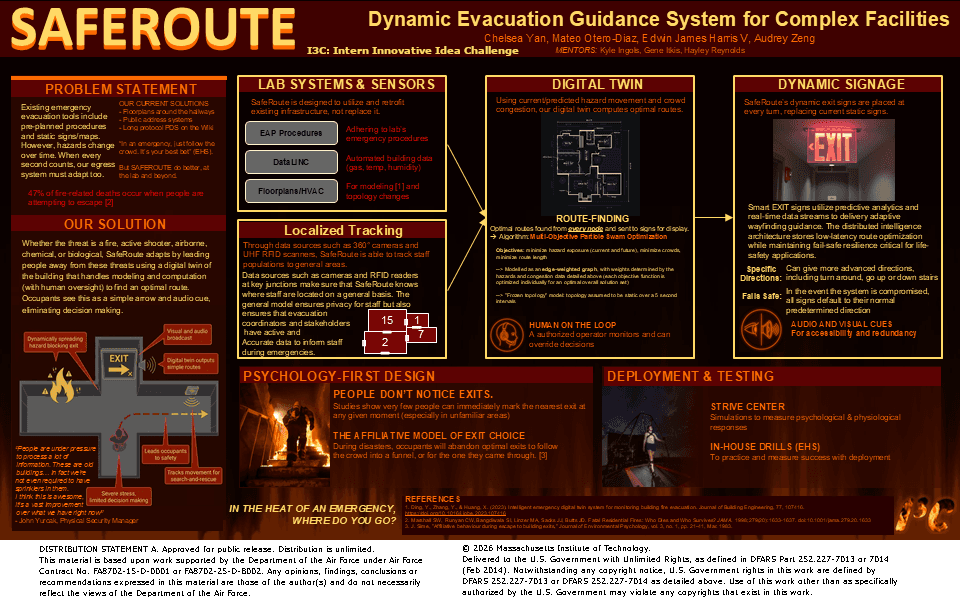
Built at MIT Lincoln Laboratory for the I3C (Intern Innovative Idea Challenge) by Chelsea Yan, Mateo Otero-Diaz, Edwin James Harris V, and Audrey Zeng, mentored by Kyle Ingols, Gene Itkis, and Hayley Reynolds. SafeRoute pairs a live digital twin of a building with adaptive exit signage: the twin computes optimal egress routes around a moving hazard (fire, active shooter, airborne, or chemical/biological threat) and pushes a single route to every sign in real time, so occupants see one arrow and audio cue instead of having to make a decision under stress.
Problem
Existing evacuation tools are pre-planned procedures and static exit signs/maps: neither adapts as a hazard moves through a building over time. 47% of fire-related deaths occur while people are attempting to escape. Current practice at the lab is public-address systems, hallway provisions, and long protocol documents on an internal wiki, none of which adapt in real time to where a hazard actually is.
Lab Systems & Sensors
SafeRoute is designed to retrofit existing infrastructure rather than replace it: EAP procedures for continued adherence to the lab's emergency plans, DataLINC for automated building data (gas, temperature, humidity), and Floorplans/HVAC for modeling and topology changes.
Localized Tracking
360° cameras and UHF RFID scanners at key junctions locate staff to a general area, coarse-grained by design to preserve staff privacy, while still giving evacuation coordinators an accurate live picture of where people are during an emergency.
Digital Twin & Route-Finding
Using current and predicted hazard movement plus live crowd congestion, the digital twin computes optimal routes for every node via Multi-Objective Particle Swarm Optimization, minimizing hazard exposure, crowding, and route length simultaneously. Edge weights come from hazard and congestion data, with topology treated as static over 5-second intervals. A human-on-the-loop operator monitors the system and can override its routing at any time.
Dynamic Signage
Smart EXIT signs at every turn replace static signage and use predictive analytics with real-time data streams to deliver adaptive wayfinding, including specific directions like turn-around or up/down stairs. The distributed intelligence architecture keeps low-latency route optimization local, and if the system is ever compromised, every sign fails safe to its normal predetermined direction. Audio and visual cues run alongside the signs for accessibility and redundancy.
Psychology-First Design
People rarely notice the nearest exit at any given moment, especially in unfamiliar space, and affiliative behavior during a disaster leads occupants to abandon an optimal exit to follow the crowd or return the way they came. SafeRoute's single-arrow, single-decision interface is designed specifically to counter both effects.
Deployment & Testing
Validated through STRIVE Center simulations measuring psychological and physiological response, plus in-house EHS drills to practice and measure deployment success.
Project Media
Documents
References
- Ding, Y., Ma, J. (2021). Intelligent emergency evacuation guidance system for reconstructing building fire evacuation. Journal of Building Engineering, 47, 103814.
- Marshall, W.J. et al. (1998). Fatal residential fires: Who dies and who survives? JAMA, 279(20), 1633–1637.
- Sime, J.D. (1983). Affiliative behaviour during escape to building exits. Journal of Environmental Psychology, 3(1), 21–41.
Tools & Methods
DISTRIBUTION STATEMENT A. Approved for public release; distribution is unlimited. © 2026 Massachusetts Institute of Technology.