DroneGym — Founders Inc
An RL training gym for autonomous FPV drones, built in one night — configure any airframe, train a policy on camera-only observations, then fly it.
🏆 Winner — beat 127 other teams | Invited to keep building at Founders Inc
Overview
DroneGym started as a fix for a teammate's gripe from the Anduril AI Grand Prix, where their drone simulations kept stalling because they rendered full camera images pixel by pixel. That felt like solving a much bigger problem than the task needed, so DroneGym fakes what the camera sees with simple geometry instead of rendering anything at all. Describe a drone's hardware and it trains a flight AI to chase a target in about five minutes on a laptop, no GPU required, then you can watch it fly. Built overnight.
How It Works
- Hand-written NumPy quadrotor sim runs at 250 Hz under a 50 Hz policy (action repeat 5)
- "Fake CV" is pure pinhole geometry returning
[bbox_x, bbox_y, bbox_size, visible], with zero pixels rendered and a drop-in swap point for a real detector later - Stable-Baselines3 PPO,
MlpPolicy [64,64], 16 vectorized envs, 4-frame stack → 48 observation dims - Curriculum promotes difficulty 0→3 on a rolling success rate
- Two scenarios: static target, and intercept, a constant-velocity crossing target framed as counter-UAS
Tech Stack
- Physics: NumPy, 250 Hz rigid-body integration
- Training: Gymnasium env, Stable-Baselines3 PPO
- Serving: FastAPI ground station backend, canvas frontend
My Contributions
Six-person team, 9 of 30 commits mine, with exclusive ownership of physics.py and config.py.
- Wrote the entire 250 Hz rigid-body integrator: quaternion math, Newton-Euler with gyroscopic coupling
J⁻¹(τ − ω×Jω), first-order motor lag, linear drag, semi-implicit Euler, per-step quaternion renormalization - Built
DroneConfigand the hardware→physics derivation: KV × voltage → RPM → thrust viact·ρ·(rpm/60)²·D⁴, frame size → arm length → inertia tensor. This is the piece that lets one policy architecture fly five wildly different airframes - Wrote
randomize_config()for sim-to-real domain randomization, randomized spawn states, and thederive_params/make_stateadapter - Added the
--scenario/--target-speedtraining flags - Wrote a physics-research literature review comparing six open-source drone simulators against ~20 papers to justify each design choice
Challenges
- Hover-centered action space: a fresh Gaussian policy outputs ≈0 mean, which under a naive thrust map commands ~5× hover on step one. Fixed by analytically inverting the physics mapping so
a[0] == 0is exact hover. - Non-Markov observation:
get_bboxreturns zeros both when the target is behind the camera and when it's off-frame, so a single frame can't tell the policy which way to yaw to reacquire, hence the mandatory 4-frame stack.
Project Media
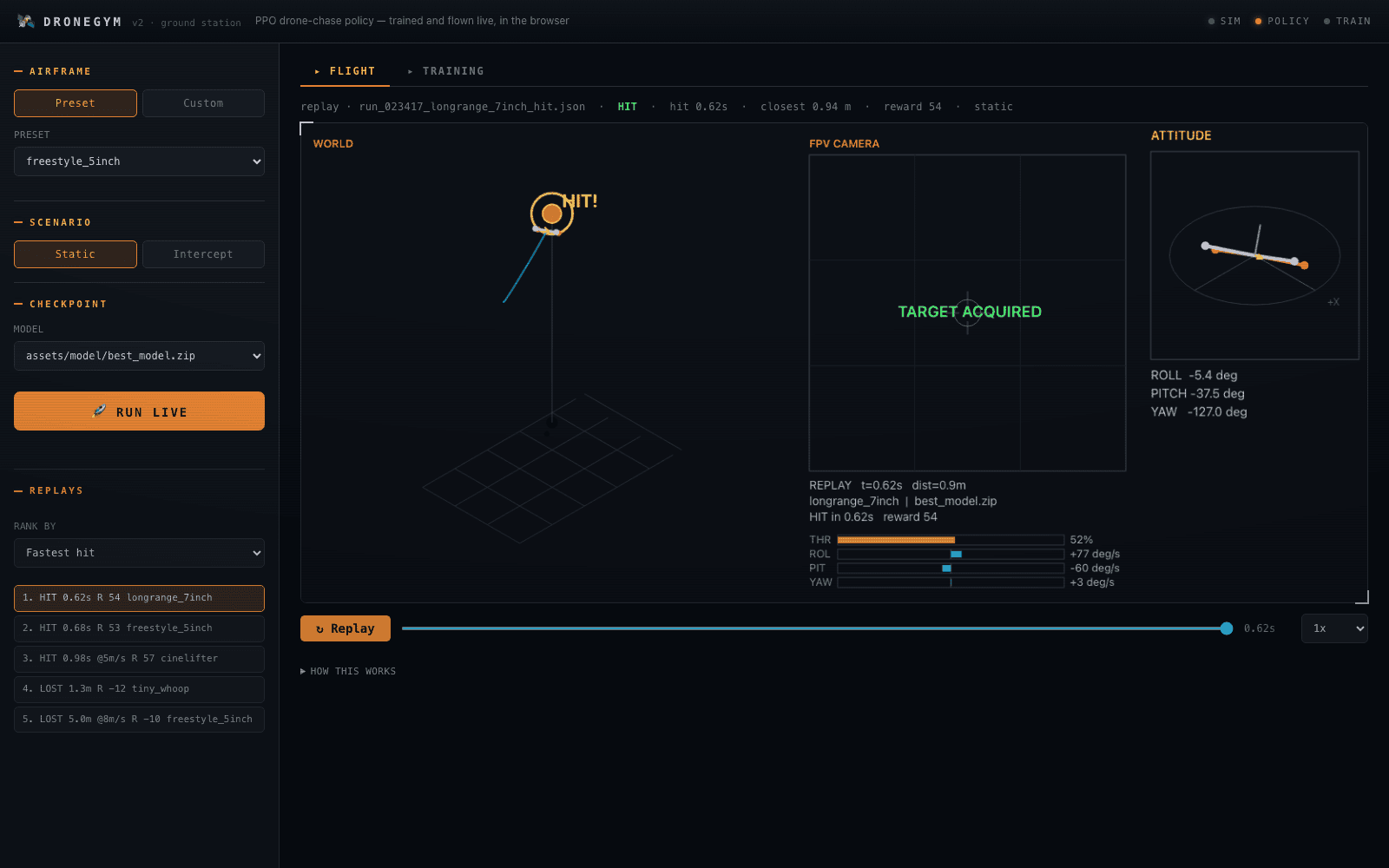
Demo video: a trained policy flying the intercept scenario.
Links
Tools & Methods
Built at Founders Inc Hack Night.